To the south of the settlement of Ancient Corinth, the imposing mass of Acrocorinth dominates. The beauty of the landscape and its important geographical position caused two gods to quarrel over its ownership. Poseidon, god of the sea, and Helios argued over who would take possession of Acrocorinth.
With the conciliatory mediation of the judge Briareus, Poseidon took the Isthmus and Helios took Acrocorinth. Later, Helios granted the lands below Acrocorinth to his son Aeetes, but Acrocorinth itself to the goddess Aphrodite.
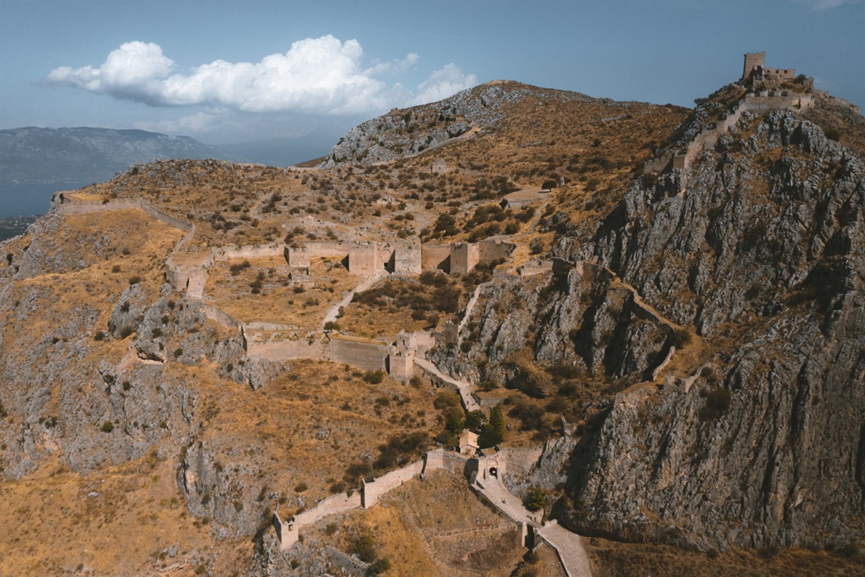
The Acrocorinth is a steep cliff 575 meters high, dominating the plain of Corinth. At its northern foot, Ancient Corinth was built. Due to its morphology, it was used since ancient times as a watchtower, which was elevated to a castle-fortress (Acropolis), from which any possible invasion, from Central Greece or from the sea, was supervised. In the language of the fighters of 1821, it was called Acrokorthos and Corinth Korthos.
With its 575m. altitude, its wild grandeur and the unique gift of nature (the god Asopos to Sisyphus), the source of the Upper Pirene. It resisted every enemy who wanted to capture the “Star of Stars”, the “Observer and Keyholder of the Peloponnese”, the “Fearsome Castle, the Beautiful of Romania”. It is the largest castle in Greece and one of the largest in Europe.
Acrocorinth is one of the largest castles in the Peloponnese. The perimeter of its walls reaches 3 kilometers. Although the final form of the castle is due to reconstructions and additions during the Ottoman occupation. Most of the fortification work was carried out in the Middle Byzantine era, more specifically during the 12th century.
The castle of Acrocorinth has functioned since ancient times as the “eye” of the entire Peloponnese.
The castle of Acrocorinth is a typical example of fortress architecture, with construction details and decorative elements from all periods of its history.
Corinth was built between the Corinthian and Argosaronic Gulfs and had two large ports, the port of Cenchrei to the east and the port of Lechaeum to the west.
” Sailing to Corinth is not for everyone.” And indeed, it was not easy for everyone to anchor in this city of lords, whose fame, in antiquity, had reached the ends of the then known world.
For its wealth and prosperity, for the excellent products of its ceramic workshops, for its temples and sanctuaries and – perhaps most enviable of all – for the priestesses of Aphrodite, who served in its numerous temples, within the city itself and its ports, but above all, in its acropolis, the imposing Acrocorinth.
In Acrocorinth, the first indications of worship date back to the 7th century BC. There was the infamous temple of Aphrodite, which, according to Stravona, had in its service over a thousand prostitutes who served the goddess.
In small, well-to-do settlements, around the temple, they practiced “sacred prostitution.” Temples of Aphrodite also existed in Lechaeum and Cenchreae.
The prostitutes led the sailors from the port to their accommodations, as they followed the imprint of their shoes on the ground that read ” ΕΠΟΥ “, meaning they followed.
The buildings on Acrocorinth show that the cult was accompanied by sacrifices, feasts and theatrical events. Perhaps purifications and some stage of initiation took place, as suggested by the limited space of some buildings, and written information that the cult statues were inaccessible to the public.
Life in Corinth was known for its loose morals, and “being Corinthian” meant living a dissolute life.
The history of Corinth, like that of Athens, is long and glorious and, according to the findings of excavations, dates back to the 5th millennium BC. From then until the beginning of the 2nd millennium BC, it experienced great prosperity.
Already from the 7th century BC the city dominated the seas and the markets. Wealth and glory flowed into the city, and in the following centuries its name became synonymous with luxury and opulence.
There was also a peculiar paved road, the Diolkos. On which they dragged the ships and their cargoes from the Saronic Gulf to the Corinthian Gulf and back. The Diolkos did not follow a straight line, because the difference in elevation along the Isthmus made it difficult to pull the ships in a straight line. The road was 3.50 to 6 m wide and was paved symmetrically with large porphyry cobblestones. Deep parallel grooves were carved along the entire length of the road, at a distance of 1.50 m from each other, to facilitate the movement of the wheels of the vehicle that transported the ship and to avoid its overturning.
This was done because the circumnavigation of the Peloponnese, around Cape Malea, was longer and more dangerous, due to frequent storms at the point of the cape. This is how the proverb was created, “if you decide to cross Cape Malea, forget that you have a family.”
Later, Neron (37 – 68 AD) attempted to open the Isthmus Canal, traces of which survived from this attempt until the modern canal was opened.
Thus, due to this position, the city became a key point and connected Rome with the East. As a result, the population and wealth increased rapidly. Its luxury remained proverbial, with the phrase “οὐ παντός Ανδρός ὁ πλοῦς προς Κορινθον” (not everyone can travel to Corinth).
The inhabitants successfully chose this location because they could well control the land route of communication, but also the sea routes, thanks to the Isthmus. While its two rich ports, Lechaio in the Corinthian Gulf and Cenchreae in the Saronic Gulf, made it a great commercial center.
The two famous and important ports of the city took their names from Lechis and Cengrias, who were beloved sons of the sea god Poseidon and the famous Peirine, daughter of the river god Achelous.
Ancient Corinth was inhabited since the Neolithic period (6500-3250 BC). The city, known since Mycenaean times, is mentioned by Homer (12th – 8th century BC) as “afneios” (= rich), due to its particularly fertile land. The large production of agricultural products, already, from early historical times. It favored the development of intense commercial activity, mainly towards the western Mediterranean. During the 8th century BC, Corinthian colonies were founded, such as Corfu in the Ionian Sea and Syracuse in Sicily, with an important role and contribution to the history of the ancient Mediterranean world.
More important, in the archaic and classical times, was the port of Lechaeum. Due to its proximity to the city and the commercial orientation of Ancient Corinth, which was mainly western. Its entire conception and construction was a technological marvel of that time, which was later copied by the Romans and applied to many ports. The port was connected to the city by long walls, 12 stadia long (2,200 m), which enclosed the famous Lechaeum Street.
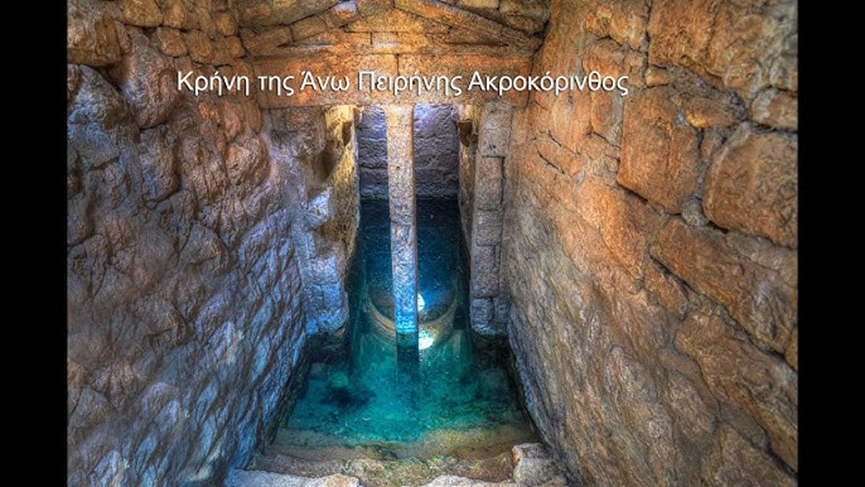
Corinth was established during the time of the mythical king Sisyphus. Sisyphus was the founder and king of ancient Ephyra, which was later named Corinth. Sisyphus solved the problem of the hill’s water shortage when he asked the river god Asopos to make a spring gush forth. In return, he would reveal to him the whereabouts of his daughter Aegina, who had been kidnapped by Zeus. Thus, Acrocorinth acquired a spring of water – they named it Peirine, in honor of Asopos’ other daughter – which gave life to the place.
The mythical king of Corinth, Bellerophon, son of the king of Corinth (or Ephyra) Glaucous (and therefore grandson of Sisyphus) and Eurynome (daughter of Nisus, king of Megara), according to Greek mythology, dedicated the place to the god Helios.
He gave the lands below Acrocorinth (where Corinth was later built) to his son Aeetes. But Acrocorinth, which was the most privileged point of the area, 240 acres, he offered to the goddess Aphrodite. Aphrodite was not moved at all by this gift, since she was clearly better off on Olympus.
In honor of the goddess, Medea built a temple on the top of the Acrocorinth. It was a humble and simple building, but the situation changed dramatically when the water reached there. Jason and Medea lived here for several years, until the tragic end of their two children and Medea’s flight.
Acrocorinth was the Acropolis of Corinth (a combination of the words Acro and Corinth), and was fortified with exceptional care.
Pausanias (2nd century AD) informs us that the rock was a great cult center in antiquity. On it were built temples dedicated to Isis and Sarapis, an Altar of the Sun, a sanctuary of Necessity and Force, a temple and throne of the Mother of the Gods, a temple of the Fates, Demeter and Kore, a sanctuary of Mountain Hera and a temple of Aphrodite.
The first fortification of Acrocorinth dates back to the late 7th-6th century BC, during the years of the tyranny of the Cypselides. By the tyrant Periander, and his father, Cypselus, in the 7th-6th century BC and slowly evolved into an Acropolis.
The power of Corinth was magnificently reflected in ornate buildings, such as the Temple of Apollo (560 BC). The elevation of the Isthmian Games – the games held at the Corinthian Sanctuary of Poseidon and Amphitrite on the Isthmus – to the Panhellenic Games (584 BC) further enhanced the city’s fame and influence.
In 660 BC, the administration of Corinth was taken over by the city’s tyrant Periander, who was among the seven sages of Ancient Greece.
From the late 6th century BC, however, the rise of Athens, and its dominance in pottery production and Mediterranean trade, gradually limited the influence of the Corinthians. After the Persian Wars (490-479 BC), they were forced to accept the primacy of the Athenians, despite their strong participation,
In the Peloponnesian War (431-404 BC) Corinth openly sided with Sparta, urging it from the beginning to turn militarily against the Athenians. Despite Athens’ defeat, however, and despite its participation in a series of military operations, including the so-called “Corinthian War” against Sparta (395-387 BC), the city of Corinth did not manage to regain its former power.
From 338 BC it passed into the possession of the Macedonians, who were expelled by Aratus and the city became a member of the Achaean League. The Macedonians repaired and strengthened the walls in the 4th century BC.
The organization of a pan-Hellenic congress in Corinth in 337 BC by King Philip II of Macedonia, the new emerging power of the Greek world, temporarily brought it back to the forefront, but very quickly, it was subjugated by the Macedonians.
The throwing off of the Macedonian yoke in 243 BC by Aratus of Sicyon was followed by its accession to the Achaean League, a federation of city-states of southern Greece.
The confrontation between the League and Rome led to the famous Battle of Lefkopetra, in the Isthmus region, in 146 BC. The Greek troops were crushed by the Roman legions under Lucius Mummius.
In 146 BC, the history of Corinth was abruptly interrupted by the complete destruction of the city by the Romans. The Corinthians put up strong resistance against them, and they, in order to take revenge on them, but also to discourage the spirit of resistance of the rest of the Greeks, punished them exemplary.
Specifically, the Roman general Mommius, with his troops, completely destroyed the city, plundered its treasures and slaughtered all the men. He sold the women, children and freed slaves as slaves. As Greek and Roman writers recount, the military defeat was followed by the complete destruction and desolation of the city. The men of the city were slaughtered, while the women and children were sold into slavery.
For about a century, Corinth was a ghost town, deserted and uninhabited. The echo of this destruction is preserved in Pausanias’ phrase “Corinth was inhabited by the Corinthians, with none of the ancients left, and settlers were sent by the Romans,” meaning that none of the old inhabitants were left.
After the destruction by Lucius Mommius (146 BC), the wall was rebuilt with the same ancient material by Julius Caesar (44 BC).
The lifelong dictator of Rome, Julius Caesar, in 44 BC, decided to re-establish Corinth as a Roman colony, recognizing its particular geographical importance in his broader strategy for the eastern Mediterranean.
His violent death, in the same year, did not thwart his ambitious plan, as it was continued by his successor Octavian, later Augustus.
The new city was named Colonia Laus Iulia Corinthiensis or Clara Laus Iulia Corinthus or Iulia Corinthus Augusta, as a colony of the Julian family of Caesar and Augustus (Gens Iulia). It was designated, in 27 BC, the capital of the Roman Province of Achaia (Provincia Achaiae), which included much of mainland Greece, the Peloponnese and several islands.
Due to its desolation, after the Battle of Lefkopetras, the city was initially settled by freed Romans and veteran soldiers, who were soon joined by Greeks, who exploited the particularly fertile land, which was confiscated by Rome and granted to new landless people.
Rome’s goal was, on the one hand, the creation of a stable Roman base in the turbulent East. On the other hand, the fastest passage of the Roman fleet through the Diolkos, the only land, paved road for ships crossing the Isthmus.
Very soon, the city’s population increased significantly, as agriculture, livestock farming and trade developed again, with corresponding exports of wool, dyed woolen fabrics, olive oil and honey, as well as timber and metal objects.
On the other hand, the needs and habits of the Roman inhabitants of the new city, as well as its international role, led to imports of goods from other regions of the Empire, such as wine and building materials (marble, granite), which were necessary for the new, luxurious constructions.
According to researchers, the city was redesigned with a hippodameian system, that is, with vertical and horizontal road axes (cardines and decumani), which delimited urban islands (insulae).
Around its Agora, ornate public buildings and private monuments were erected by wealthy Romans and Greeks who wanted to emphatically declare their presence in the capital of the Province.
Because of these actions of the two above emperors (Julius Caesar – Octavian), the city begins to find its former glory and riches, but with the difference that its inhabitants were of different ethnicities.
From 267 AD, with the invasion of the Heruli, the decline of the city began again, which intensified in 346 AD with the invasion of the Visigoth Alaric and his hordes.
During the Byzantine period, the city experienced a recovery, with the reconstruction by Justinian, who fortified it and designated it as the seat of the Byzantine theme of the Peloponnese.
Another repair was carried out in the 6th century by Justinian and some additions were observed until the 12th century.
Also, during the time of Justinian, the great wall was built on the Isthmus (Examilion). To stop barbarian raids, where centuries earlier, the Mycenaean wall had been built to stop the Dorians.
The city had a particularly strategic position, since 400 men could stand on the wall of the Isthmus to intercept any enemy threat. The commercial importance of the city was also great, since all trade between East and West passed through it. The two ports of the city contributed to this, the eastern one, Cenchreae, and the western one, Lechaeum. Of particular importance was the passage from the Diolkos of Corinth. A paved road, through which ships and their cargoes were transported from the Corinthian Gulf in the west, to the Saronic Gulf in the east.
At the end of the 10th century AD, Corinth experienced a great industrial boom, which brought it great wealth.
In 1146 it was destroyed by the Normans, who plundered its treasures.
In 1208, the Lord of the Castle was Leo the Curly (…..- 1208 AD).
Until then, he had defeated the Frankish invaders, despite the fact that, during the first siege of the Castle, they had built a small control fort (Penteskoufi), which survives to this day, opposite the entrance to Acrocorinth.
But now, the food is not enough and it is occupied by the Franks.
Curly, abandoned by everyone. He blindfolds his beloved horse, opens a gate in the wall on the cliff, spurs it on and writen down in history, as defying the conqueror.
In early 1210, Corinth fell into the hands of the Franks, under the jurisdiction of the principality of Achaia.
The Castle passes into the hands of the Despot of Epirus, Michael I, who entrusts it to his nephew Theodore. After a 5-year siege, he will hand it over to William of Villehardouin, who will thus conquer the entire Peloponnese.
In the mid-13th century, extensive repairs were made to the walls.
At the beginning of the 14th century AD, the castle was granted to Prince John Gravina and later to N. Acciajuoli, who repaired the old fortifications and added new ones.
In 1395, the castle became the property of Theodore Palaiologos, Despot of Mystras, who inherited the castle from his deceased father-in-law, Nerios I Atsagiolis, Duke of Athens.
In 1397, Palaiologos, for financial reasons, sold it to the Knights of St. John of Rhodes, who held it until 1404, when Palaiologos regained it.
In 1458, Sultan Mehmed II overcame the resistance of the Byzantine commander Matthew Asan and captured Acrocorinth, inside which four mosques were built.
In 1687, the Venetians captured the Castle and carried out fortification works, which were completed in 1711 and gave it its current form.
In 1715, the Turks besieged Acrocorinth and occupied it. This is when the destruction of the Monuments of Ancient Corinth began, as the Turks preferred to settle in this privileged part of the hill with the stunning view.
There will also be built the Serai of the Turkish Governor (Bey). The most famous of them, Kiamil-Bey, who will be the last Turkish Bey of Corinth. He accumulated a huge treasure: 40,000 bags of gold coins that his widow gave to Dramalis.
On 14-1-1822, Theodoros Kolokotronis liberated Acrocorinth, holding the blue and white flag ( Greek flag ) in his hand. It was the first time in modern Greek history that the Greek Flag was flown and flown on Acrocorinth. One of the great, deeply moving moments of our history was associated with him.
In July 1822, Dramalis recaptured it without a fight, after its defenders had previously abandoned it.
In October of the same year, Dramalis died at the age of 52 from languishing in Corinth. From his grief over the great destruction of his army. In fact, his death seems to have been caused by the typhus that was plaguing his army at that time.
In early 1823, the siege of Acrocorinth by the Greek revolutionary forces begins for the third time. The National Assembly of Astros appoints the leader of the siege, the Corinthian Ioannis Sot. Notaras. In June, a fellow soldier and conqueror of Palamidi, Staikos Staikopoulos, arrives. While in October, to further pressure matters, the Executive also appoints Gennaios Kolokotronis.
When all hope of escape or salvation from the outside for the prisoners had been ruled out, a Turkish official in Acrocorinth, Halil-Agas, submitted proposals for the surrender of the Castle. The main reason was to hand them over to Theodoros Kolokotronis, because he was the only one they considered “unshakable”, capable of keeping his word and preventing the prisoners from being slaughtered.
After persistent negotiations, the garrison commander Abdoulah Bey and Theodoros Kolokotronis reached an agreement.
The surrender treaty was signed on October 19, 1823, but the Turko-Albanians left the Castle on October 26, because in the meantime an inventory was made of the things that would be handed over to the Greeks.
At noon on October 26, 1823, on the day of Saint Demetrius, 300 Turkish-Albanians and 60 women abandoned Acrocorinth into the hands of the Greeks.

The view from Acrocorinth will take your breath away. In front of you stretches the entire Corinthian land, up to the borders of Argolida and across to Central Greece. Above Geraneia and up to the borders of Achaia. Magical “Observatory of the Peloponnese”.
Within this area there are today only ruins of older towers and various buildings, underground passages, wells, warehouses and tanks for the construction and completion or reconstruction, etc. of which many generations of people worked. From the last Venetian occupation under Francesco Morosini, some cannons are brought, one of which is dated 1670.
The most remarkable thing about this area is the water tank called “Dragonera” today, which is the ancient Peirini, according to Pausanias’ description. The view from this level is extremely magnificent, covering the Patraikos and Corinthian Gulfs, the southern coasts of Central Greece, the entire western part of the Saronic Gulf, Salamis and Aegina.
Conservation and restoration work has been carried out at individual points of the wall and at a few buildings. Around 1930, protection and conservation work was carried out at the Upper Peirini Fountain. In 1965-66, the moat bridge and the entrance gate were restored. In 1972-73, reinforcement work was carried out on the wall between the first and second gates. In 1978, reinforcement of the northern end of the wall of the second enclosure, near the Kanoni position.
In 1980, reinforcement of parts outside the third enclosure was carried out. In 1993-95, the moat bridge was replaced and direct reinforcement work was carried out on the wall, between the second and third gates, as well as parts of the cobblestones.
The castle includes a large, uneven courtyard, occupies an area of 61.776 acres or 25 hectares and is a typical example of fortress architecture. The walls follow a polygonal path, according to the natural line of the rock, and are reinforced at intervals by towers and bastions.
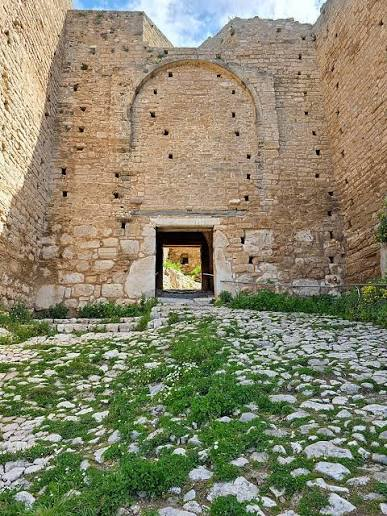
They are built in three defensive rows and are reinforced with towers, bastions, perforated ramparts, with loopholes and cannon ports. In front of the A gate there was a moat, with a wooden drawbridge. A cobblestone path leads to the three consecutive gates. The A gate is arched and crowned with a blind arch, where a Byzantine marble slab survives, the second gate is an impressive tower-like two-story structure. Inside, a stone staircase leads to underground vaulted rooms. The third gate is decorated with a blind horseshoe-shaped arch and is flanked by two powerful towers.
The Byzantine fortification followed the carving of the ancient walls on the brow of the rock and incorporated parts of them that are visible to this day.
On the SW side of the castle stands the two-story Frankish watchtower with a stepped base and a battlement window. The lower floor was a cistern.
The average thickness of the walls is 2 meters, the thickness of the parapet varies between 60 and 70 points with successive openings of about 1.65 meters in height.
After the 3rd row of walls, the area where they are located spreads out: the ruins of the Magnificent Temple of Aphrodite, a 16th-century Mosque, a Minaret, a Byzantine-era Tank, which is probably the Byzantine Metropolis that the Venetians razed and turned into a tank, the Tower of Villehardouin, the underground Ano Peirini Fountain (the locals call it Dragonera) and the well-preserved eastern row of walls.
The Temple of Aphrodite is at the highest point of Acrocorinth. From there, the visitor can gaze over a vast area: Kithairona, Ziria, Panachaikos, Central Greece, the plain of Argos, the entire Corinthian Gulf, the Saronic Gulf, and when there is great clarity, the Acropolis of Athens can be seen.
A few daffodils always grow at this spot. It is now the only memory of the cool priestesses of Aphrodite who for about 700 years gazed upon their homelands from the exact same spot, from the place that was famous throughout the ancient world.
The mountain is a rich botanical garden, with many endemic wildflowers of the Greek land and belongs to the European network of habitats “NATURA 2000”. The area is full of micro flowers, herbs and wild plants of particular beauty, but also of architectural value! Walk carefully, keep your eyes open and get ready to see the acanthus, the plant from which the sculptor Callimachus was inspired by the Corinthian capital. You will definitely see the famous ornithogalum, with which bridal wreaths were decorated in ancient Greece, orchids and wild bulbs in vibrant colors, a delicious delicacy of the ancient world.
The vegetation of the hill also includes shrubby, rocky scrub and phrygana. Protected species of flora include the rod-shaped Stachys and the Greek Fritillaria. Protected species of fauna include: the Peloponnese toad, green toads, snakeheads, house snakes, eyeless snakes, golden jackals, curled-toed snakes, white-tailed snakes, blind snakes, myotids, rhinoceros beetles, Rhodes butterflies, fringed turtles, tyrannosaurs, etc.
Because the castle was in constant use from early antiquity until recently, the buildings have been demolished and rebuilt several times, while the building material has been used many times to meet the needs of the times.